
DCVA for low hazard, RP for high hazard, PVB for irrigation. A side-by-side table, how to identify yours by looking at it, and why the survey decides which one you need.
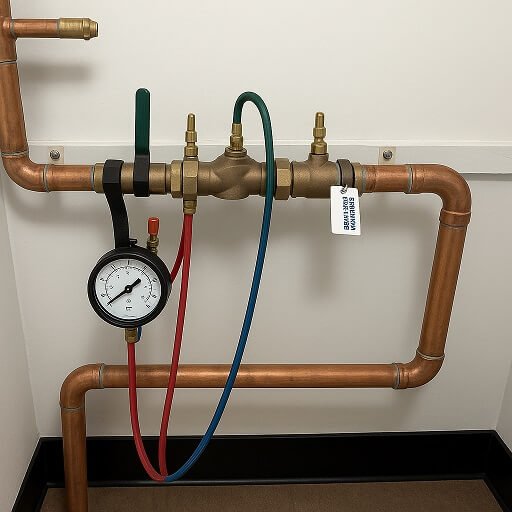
A survey report or a plumber’s quote says you need “an RP”, and you’re not sure whether that is a different device from the one already bolted to your wall. Or you are pricing a replacement and the three options differ by hundreds of dollars for reasons nobody has explained.
Quick answer
- A DCVA (double check valve assembly) has two check valves and protects low-hazard premises.
- An RP or RPZ (reduced pressure principle assembly) adds a relief valve that discharges water, protects high-hazard premises and needs a drain nearby.
- A PVB (pressure vacuum breaker) is the usual irrigation device; it stops back-siphonage only, not back pressure.
- Device selection follows CSA B64.10 and is set by the hazard level downstream, not by price.
- All three are testable and are tested once every 12 months by a certified Cross Connection Control Specialist.
What is the difference between a DCVA, an RP and a PVB?
The level of hazard each one is built to stop. All three sit on the incoming potable water line and stop contaminated water flowing backwards into the supply, but they use different internals.
| DCVA | RP / RPZ | PVB | |
|---|---|---|---|
| Protects against | Back pressure and back-siphonage | Back pressure and back-siphonage | Back-siphonage only |
| Hazard level | Low hazard | High hazard | Irrigation and other back-siphonage-only connections |
| Typical uses | Offices, low-hazard commercial, fire sprinkler lines (as a DCDA with bypass meter) | Restaurants, dental and medical, car washes, industrial and process water | Lawn and landscape irrigation systems |
| Needs a drain? | No | Yes; the relief valve discharges | No, but it is mounted above the irrigation piping it protects |
| Testable? | Yes | Yes | Yes |
| Test cocks | Four | Four | Two |
Our explainer on types of backflow prevention devices covers the DCDA as well.
How do I tell which backflow preventer I have?
Look for three things: a relief valve port underneath, a canister on top, and how many test cocks it has. Most devices take under a minute to identify.
- Relief valve port underneath, between the two check valves, often with a funnel or air-gap fitting running to a drain: that is an RP. An occasional drip is normal; a steady discharge means it needs service.
- A domed canister or bonnet on top, device mounted up high near the irrigation controller, and only two test cocks: that is a PVB.
- Two valves in line, four small test cocks along the body, no relief port and no canister: that is a DCVA.
- A DCVA with a small bypass loop and a little meter on it, on the fire sprinkler line: that is a DCDA.
Still unsure? Most tags name the device type. If the tag is gone, send us a photo and we’ll identify the device and tell you when it is next due.
Which device does my property need?
The one that matches the hazard level of what sits downstream, selected under CSA B64.10. Hazard is about what could flow back into the drinking water if pressure reversed, and it is determined by a cross-connection control survey, not by the owner or the installer’s preference.
A low-hazard premise, such as an office with nothing worse than domestic plumbing, is usually protected by a DCVA. Anything with chemicals, process water, medical or food-service equipment is high hazard and calls for an RP. Irrigation systems commonly take a PVB where the irrigation line leaves the building supply.
Downgrading is not an option. If a survey calls for an RP, installing a DCVA because it is cheaper and needs no drain leaves the property non-compliant. In Toronto, any new installation or replacement also needs a building permit before the work.
Why does an RP need a drain when a DCVA doesn’t?
Because the RP is designed to dump water on purpose. Its relief valve opens when the pressure between the two checks rises toward supply pressure, which is exactly what happens when a check valve fails. That discharge is the device protecting the supply, and it has to go somewhere.
A DCVA has no relief valve, so nothing comes out of it even when a check fails, which is why it is accepted only where the hazard is low. The trade-off is that an RP installation needs a floor drain or indirect waste sized for the discharge, and not every mechanical room has one.
Need the right device, not just a device? We survey, size and install under a fixed quote, and the first test is included. Testing any DCVA, RP or PVB is $350 for a single device. Ask for a quote or call (647) 578-9903.
Does the device type change the cost of testing?
Not the annual test fee. Backflow Inspector, a service of MT Drains & Plumbing, tests any DCVA, RP, PVB or DCDA for $350 as a single device, with multi-device sites priced per device on a sliding scale, as low as $200 per device on larger properties. The test, tag, digital report and filing are included regardless of type.
What does change with type is repair cost. An RP has more internals, including the relief valve, so a repair kit is priced differently from a DCVA kit. Repairs are always quoted before any work, and in Toronto the retest after a repair must happen within 72 hours.
What do back pressure and back-siphonage actually mean?
They are the two conditions that cause backflow, and they decide whether a PVB is enough. Back-siphonage is a drop in supply pressure that sucks water backwards, such as a main break or hydrant draw. Back pressure is downstream pressure higher than the supply, from a pump, a boiler or an elevated tank pushing water the wrong way.
A PVB stops the first but not the second, which is why it is fine on a lawn system and wrong on anything with a pump. For the plain-language version, start with what a backflow preventer is, then run our 30-second eligibility check.
Quick answers
Not sure which device you have or need? Ask us
Send a photo and we’ll identify it, or book a survey and fixed-quote installation. Annual testing of any DCVA, RP or PVB is $350 for a single device, report and filing included.