
A failed backflow test means repair or replacement, then a retest within 72 hours in Toronto and a new filing. Common causes, usual fixes, and why the test fee does not change.
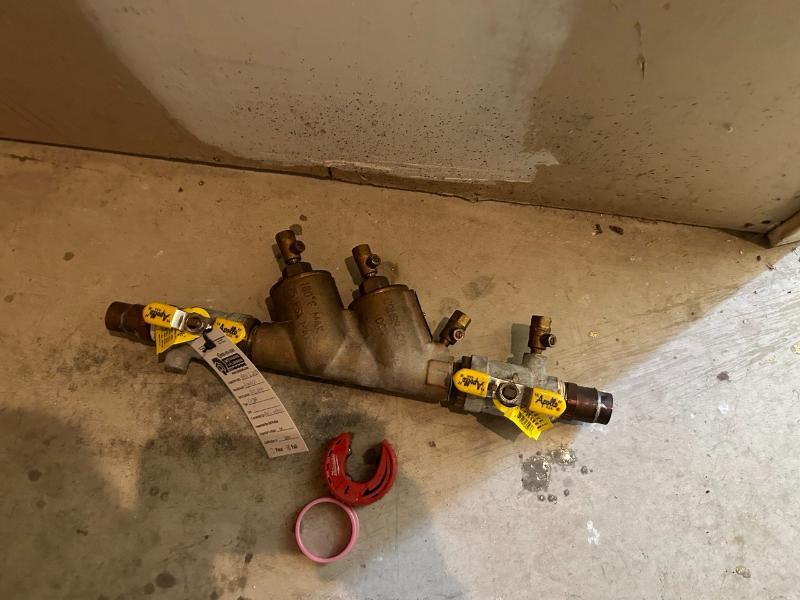
The tester has just told you the device failed. Water is running out of the bottom of the RP in your mechanical room, or a check valve would not hold, and you now have a report that says “fail” with your address on it. The clock is already running.
Quick answer
- A failed backflow test still produces a report, and the device must be repaired or replaced and retested before the property is compliant.
- In Toronto the retest must happen within 72 hours of the repair, service or replacement.
- Most failures are worn check seats, debris on a disc, a stuck relief valve or a tired spring, and most are fixed with a repair kit, not a new device.
- The test fee does not change on a fail; repairs and parts are quoted separately before any work.
- The passing retest is filed online with the municipality and closes the file.
What happens immediately after a backflow preventer fails its test?
The tester records the failing readings and submits the report as a fail. The property is now formally non-compliant, and the next step is a repair or replacement followed by a passing retest. A failed test is not an emergency for the building, but it does start a timeline.
In most cases the water stays on. The fail usually means a check that leaks slightly or a relief valve that opened early. An RP discharging steadily is the exception, and we treat it as a same-day repair.
What are the steps from a failed test to a filed pass?
Report, quote, repair, retest, file. Five steps, and on most devices the whole sequence takes one return visit.
- The failing report is recorded. The readings, device details and reason for the fail go on the report. Ask for a copy; you may need it if the City asks what is being done.
- You receive a repair quote. Parts and labour are quoted before any work. On most devices this is a kit for the failing check or relief valve; a replacement is quoted only when the body is damaged or parts are no longer made.
- You approve the work. Repairs are done on a return visit with the parts in hand. If a replacement is needed, a building permit is obtained first in Toronto.
- The repair is completed and the device is retested within 72 hours. Checks, seats, springs or the relief valve are replaced, the device is flushed and reassembled, and the retest is done at the end of the same visit so there is no gap.
- The passing report is filed. The retest report goes to the municipality through the online form, a new tag goes on the device, you get a copy and the file is closed.
No double charge: the annual test is $350 for a single device whether it passes or fails. The repair is quoted separately, and you decide before anyone opens the device.
Why do backflow preventers fail, and what is the usual fix?
Wear and debris. The internals are rubber seats, discs and springs working against grit in the municipal supply and years of pressure swings, and almost every failure traces back to one of those parts.
| Symptom or failure | Usual cause | Usual fix |
|---|---|---|
| Check valve will not hold (reading drops during test) | Debris on the disc or a worn rubber seat | Clean and inspect, or replace the check kit |
| Relief valve discharging continuously (RP) | First check leaking, or a worn relief valve diaphragm or seat | First check kit or relief valve kit |
| Relief valve opens too early or not at all (RP) | Spring or diaphragm failure | Relief valve kit |
| Water from the canister (PVB) | Fouled air inlet or check seat, or freeze damage | Clean or replace the bonnet and poppet; replace the device if cracked |
| Test cocks leak or will not close | Worn test cock seals | Replace the test cocks |
| Shut-off valves will not isolate | Seized or worn gate valves | Replace the shut-offs; without isolation the test cannot be completed |
| Cracked body or heavy corrosion | Freeze damage or age | Replace the device |
For the symptoms you can spot between tests, see our post on common backflow preventer issues.
Should I repair or replace a failed backflow preventer?
Repair, unless the body is damaged or the parts are obsolete. A repair kit restores the device to factory tolerance at a fraction of the cost of a new assembly and avoids the building permit a replacement needs in Toronto. When the decision is close we quote both.
- Repair: worn or fouled internals on a device whose body and shut-offs are sound and whose parts are still available.
- Replace: a cracked body, heavy corrosion, parts no longer made, or a device that is the wrong type for the hazard identified in a survey.
- Either way: the retest and filing are part of the repair or replacement job, not a separate appointment.
Failed today? Backflow Inspector, a service of MT Drains & Plumbing, carries kits for the common DCVA, RP and PVB models, quotes before opening the device and retests on the spot. Call (647) 578-9903 or send us the failing report for a fixed repair quote.
Does a failed test trigger a notice from the City?
Not by itself, as long as the repair and passing retest follow quickly. The failing report tells the municipality the device is being dealt with. What draws a compliance notice is a fail with no passing report after it, or a retest that was done but never filed.
Watch the 72 hours. A repair by one contractor and a retest booked with another a week later breaches Toronto’s by-law even if the device passes. Use one certified Cross Connection Control Specialist for the repair and the retest.
If a notice has already arrived, our guide to the first 30 days after a Toronto backflow notice walks through closing it, and how the Toronto test report is filed explains what the City needs to see.
Quick answers
Failed test? Fixed repair quote, retest on the spot
We quote the repair before opening the device, retest within the 72-hour window and file the passing report — the $350 test fee does not change because the device failed.