
Restaurants, dental offices and car washes are high-hazard premises that usually need an RP at the water entry plus devices on equipment. What is required and what the visit looks like.
You run a kitchen, a clinic or a wash bay, and someone has told you that you need “a backflow test”. Maybe it was a City letter, your landlord or the equipment installer. Your water is fine and your customers are happy, so why is your business treated differently from the office next door?
Quick answer
- Restaurants, dental offices and car washes are high-hazard premises because chemicals or contaminants connect directly to the water supply.
- High-hazard premises are normally protected by an RP (reduced pressure principle assembly) at the water entry, called premise isolation, often with further devices on specific equipment.
- Every device is tested individually once every 12 months by a certified Cross Connection Control Specialist, and the report is filed with the municipality.
- Testing happens during business hours with only a few minutes of interruption per device; you do not need to close.
- Multi-device sites are priced per device, as low as $200 per device.
Why are restaurants, dental offices and car washes classed as high hazard?
Because each one connects something toxic or infectious to the potable water line. Hazard level under CSA B64.10 is about what could flow backwards into the drinking water if pressure reversed, and these three premises all have obvious candidates.
- Restaurants: soda carbonators, chemical dispensers feeding dish machines and sanitiser stations, and mop-sink hoses left sitting in buckets.
- Dental offices: vacuum and suction lines, steriliser and autoclave connections, and dental unit water lines that reach the patient’s mouth.
- Car washes: wash-bay chemical injectors, high-pressure pumps that create back pressure, reclaim-water systems and hoses lying in puddles.
Any one of these can push or pull contaminated water back into the supply through back pressure or back-siphonage, so the municipality treats the whole premise as high hazard no matter how clean the operation is.
Which backflow preventer does a high-hazard business need?
An RP, almost always, installed where water enters the premises. This is premise isolation: it protects the public main from everything inside your walls, and it is the device a City survey will usually require.
A DCVA is not accepted for high hazard because it has no relief valve and gives no visible sign of failure. The RP’s relief valve discharges when a check fails, which is why it needs a drain and why a dripping RP is a signal, not a nuisance. Our comparison of DCVA, RP and PVB devices explains the difference.
Tenants: in a plaza or mixed-use building there is often one RP for the whole building and another on your unit. Your lease decides who pays for testing and repairs; the property owner answers to the City.
How many devices does a typical restaurant, clinic or car wash have?
Usually more than one. There is the premise isolation device at the entry, and then the devices on individual connections that the equipment or the survey calls for. Each one is tested and reported separately.
| Premise | Premise isolation | Typical additional devices |
|---|---|---|
| Restaurant | RP at the water entry | Carbonator line, dish machine chemical feed, fire sprinkler line (DCDA) |
| Dental office | RP at the water entry, or at the suite in a multi-tenant building | Dental unit water lines, sterilisers, vacuum system make-up water |
| Car wash | RP at the water entry | Chemical injection and reclaim feeds, heater or boiler make-up, fire sprinkler line (DCDA) |
If you do not know how many devices you have, a cross-connection control survey answers it and produces the list the municipality wants to see.
Several devices on site? One visit, one report per device, one invoice. Single-device testing is $350, with multi-device sites priced per device on a sliding scale, as low as $200. Get a fixed quote or call (647) 578-9903.
What does the test visit look like during business hours?
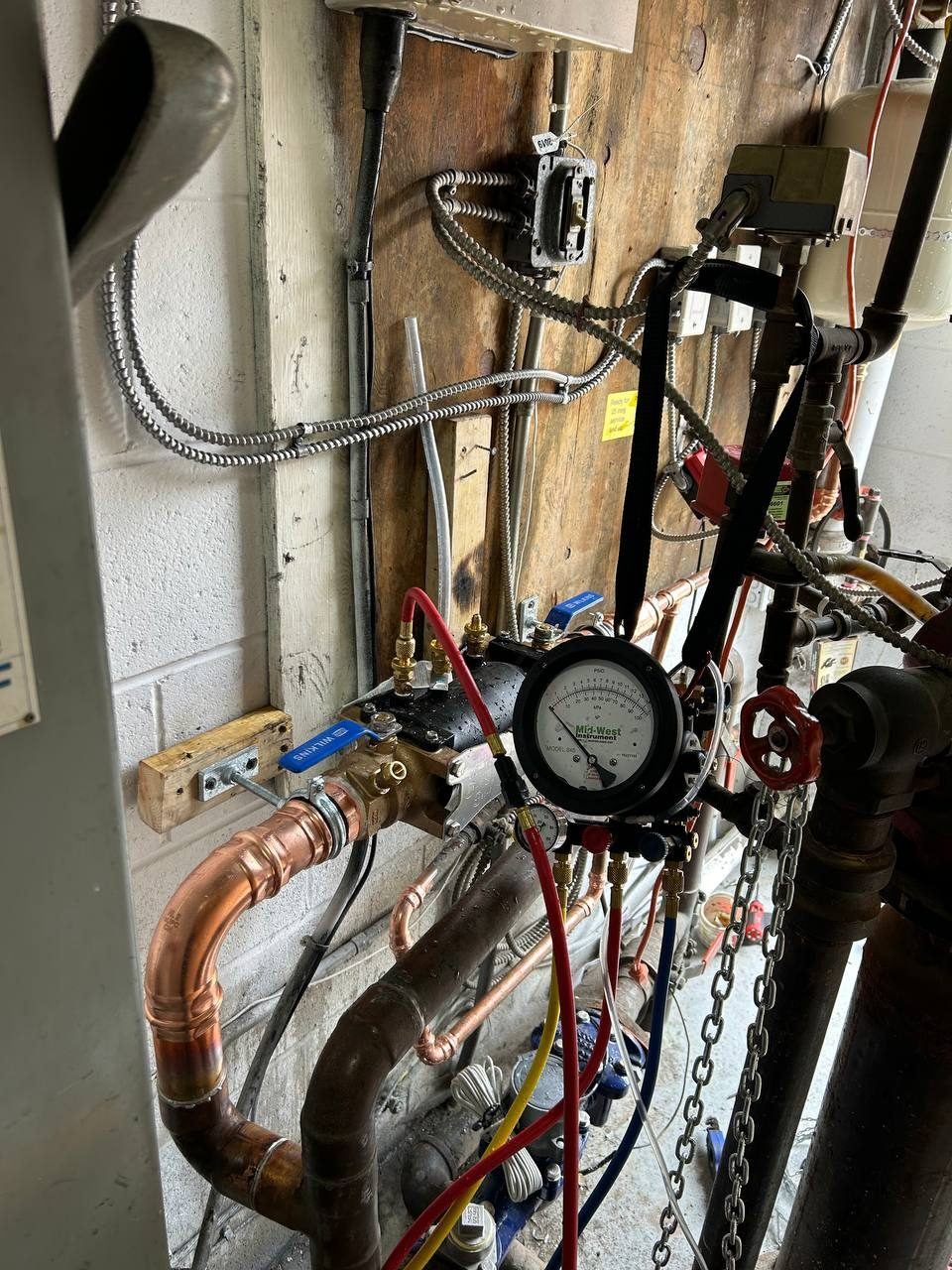
Short, quiet and scheduled around your service window. The tester isolates each device for a few minutes, connects a calibrated gauge to the test cocks, records the readings and tags the device. Water downstream of that device is off only while the gauge is connected.
- Booking. We pick a time outside your rush: before lunch service, between patients, or first thing before the bays open.
- Access. Each device needs to be reachable, often in a back room, under a counter or in a utility closet. Clearing the space beforehand shortens the visit.
- The test. Each device is isolated, tested and reopened. A soda line or dish machine loses water only for the minutes its own device is being tested.
- The tag and report. A new tag goes on each device and the digital report is filed with your municipality for you, with a copy to your inbox.
- Repairs if needed. A fail is quoted before any work, and in Toronto the retest happens within 72 hours of the repair. We do it on the spot where parts allow.
Backflow Inspector, a service of MT Drains & Plumbing, tests restaurants, clinics and wash bays across Toronto, Vaughan, Mississauga and the rest of the GTA with certified Cross Connection Control Specialists.
What happens if a high-hazard premise skips testing?
The municipality issues a compliance notice and the premise is non-compliant until a passing report is filed. Because the hazard is high, these properties are the ones surveyed first and followed up on, and the by-law provides for penalties and water-service measures for continued non-compliance. Losing water service is the one outcome none of these businesses can absorb.
New fit-out or change of use? A new restaurant, clinic or wash bay needs the device installed under a building permit and tested at installation, before the annual cycle starts. Our installation service handles the permit, the install and the first test.
Still not sure whether your business falls under the program? The 30-second eligibility check will tell you, and the FAQ covers the questions owners ask most.
Quick answers
High-hazard premise? One visit covers every device
We test, tag and file every device on your site around your business hours — $350 for a single device, as low as $200 per device on multi-device sites, fixed quote before booking.