
Your backflow preventer is usually just past the water meter. Here is where to look, what the assembly looks like, what the test tag tells you and what an old or missing tag means.
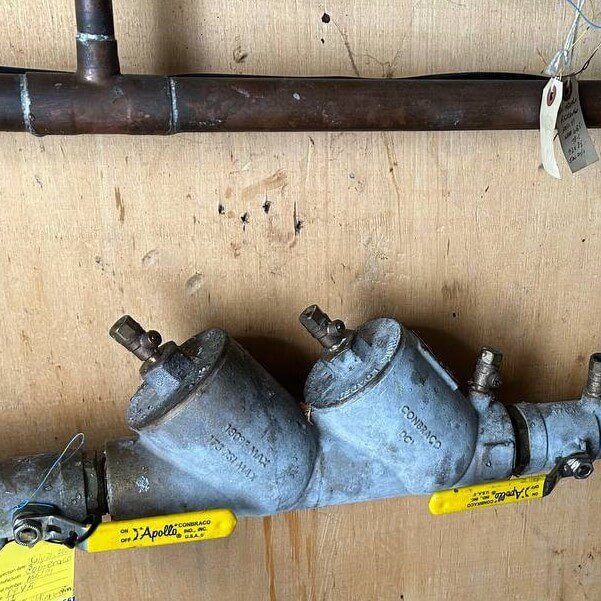
The City letter says your backflow preventer is due for testing, and you are not entirely sure where it is. You are not alone. Most property managers inherit these devices with the building and have never had a reason to go looking for one.
Quick answer
- Start just downstream of the water meter where the main enters the building, usually in the mechanical room or basement.
- Look for a brass or bronze assembly with a shut-off valve at each end, four small test cocks along the body and, on an RP, a relief valve with a drain beneath it.
- The test tag hangs from the assembly and shows the test date, the tester’s name and certification, the pass or fail result and the device serial number.
- No tag, or a test date more than 12 months old, means the device is overdue and the property is likely non-compliant.
- Separate devices often sit on irrigation, boiler make-up and fire sprinkler lines, and each one is tested individually.
Where is my backflow preventer located?
Your main backflow preventer is almost always within a few feet of the water meter, on the building side, in the mechanical room or basement where the water service enters.
Check these five places in order:
- Just after the water meter. The premise isolation device protects the City’s main from everything in your building. Follow the pipe from the meter and you will usually find it within arm’s reach.
- The mechanical or boiler room. Look for a smaller device on the make-up water line feeding the boiler or heating loop. Glycol or chemically treated water is a high-hazard connection.
- The irrigation controller or valve box. Outdoor systems typically use a pressure vacuum breaker (PVB) mounted above ground near the controller or inside a green valve box in the lawn.
- The fire sprinkler riser. The fire line has its own device, usually a double check detector assembly (DCDA) with a small bypass meter attached.
- Tenant equipment. Commercial kitchens, dental clinics, car washes and labs often have their own devices on carbonators, sterilizers or chemical feeds.
What does a backflow preventer look like?
It looks like a short section of heavy brass or bronze pipe with a shut-off valve at each end, four small test cocks along the body and a nameplate stamped with the make, model and serial number.
The type matters because it tells you the hazard level the device was chosen for:
- DCVA — two check valves in a row, no relief port, used for low-hazard connections.
- RP or RPZ — two checks plus a relief valve on the underside that discharges water when a check leaks, used for high-hazard connections. It needs a drain or funnel nearby.
- PVB — a vertical unit with a bonnet on top, common on irrigation, protecting against back-siphonage only.
- DCDA — a DCVA with a bypass meter, used on fire sprinkler lines.
Our guide to types of backflow prevention devices explains how each one works.
Leave the valves alone: do not open test cocks or close the shut-off valves to see what happens. You can interrupt water to the building, trip an alarm on a sprinkler line or make an RP discharge onto the floor. Finding and reading is enough.
What does the backflow test tag show?
The tag is a small card or plastic tag wired to the assembly by the tester. It records the date of the last test, the tester’s name and certification number, the pass or fail result and the device serial number.
Read it the way an inspector would:
- Test date — your next test is due 12 months from this date.
- Result — a fail tag with no newer pass tag means the device was never repaired and retested.
- Tester and certificate — only a certified Cross Connection Control Specialist can file a valid report.
- Serial number — it should match the nameplate on the device and the number on your report.
Found the tag and the date is close? We test, tag and file the report for $350 for a single device, less per device for multi-device sites. Get a fixed quote or call (647) 578-9903.
What if there is no tag or the date is over 12 months old?
Treat the device as untested. In Toronto the Water Supply By-law requires a passing test every 12 months, so a missing tag or an old date means your property is overdue and a compliance notice may already be on its way.
A tag is only the field record. The report filed with the municipality is what counts, so if the tag is missing but a previous manager insists the device was tested, ask Toronto Water for the filing history at 416-394-8888 or backflow@toronto.ca.
If the device has no tag, is corroded or is dripping from a relief port, mention it when you book. The usual faults are covered in our post on common backflow preventer issues.
How do I prepare for the tester’s visit?
Know where every device is, make sure the tester can reach each one, and warn anyone affected that water may be off briefly. Backflow Inspector, a service of MT Drains & Plumbing, confirms these details with you before the visit, and this checklist covers them:
- A list of every device and its location, including irrigation and fire lines.
- Keys or access codes for mechanical rooms, roof hatches and tenant spaces.
- A clear path to the device — no stored boxes stacked in front of it.
- The previous report, if you have one, so serial numbers can be matched.
- Any City notice, so the tester can reference it when filing.
- The name and email of the person who should receive the digital report.
If you cannot find a device at all, book a cross-connection control survey and we will locate and document every one on the property before the annual test.
Quick answers
Found your device? We will handle the rest
Send us a photo of the tag or the assembly and we will quote the test, tag and filing — $350 for a single device, less per device for multi-device sites.