
Your irrigation PVB is the one backflow device that freezes. A fall winterizing checklist, a spring start-up and test sequence, and how to find out whether your municipality requires the test.
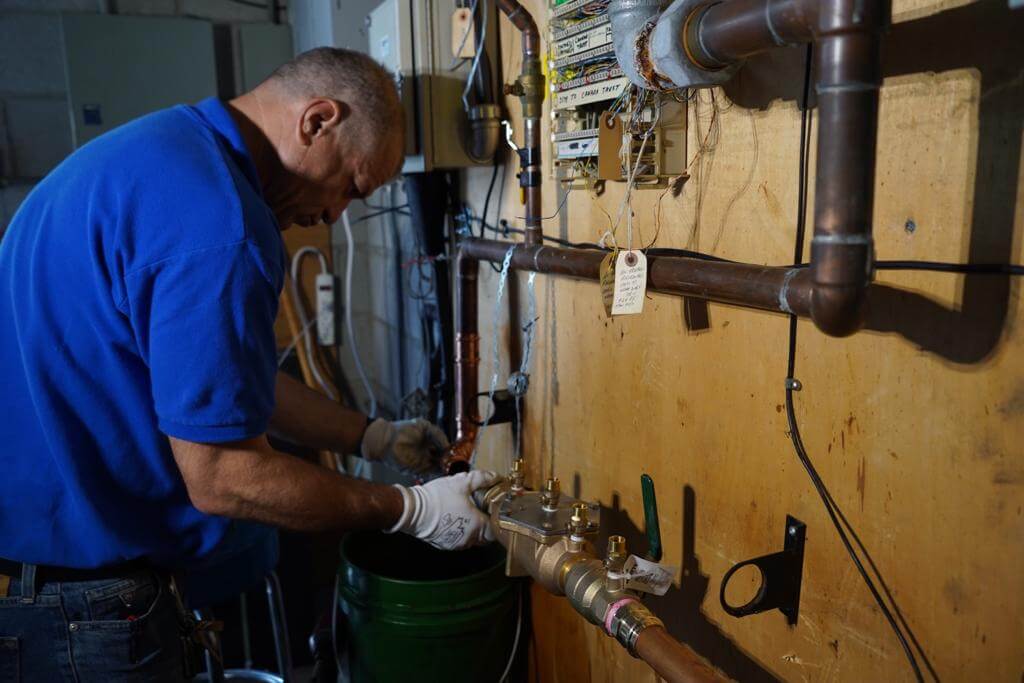
The sprinkler contractor blew out the lines last fall and you have not thought about the brass device on the side of the house since. Now the season is about to start, and a neighbour mentioned their irrigation device had to be “tested and filed”. Does yours?
Quick answer
- Irrigation systems are almost always protected by a pressure vacuum breaker (PVB), which stops fertiliser, pesticide and soil water siphoning back into the house supply.
- A PVB is the one device on most homes that freezes, so fall winterizing (shut off, drain, blow out, protect) is what prevents a spring failure.
- Where testing is required it is once every 12 months, ideally in spring before the system runs, by a certified Cross Connection Control Specialist.
- Whether a residential irrigation device must be tested and filed varies by municipality; in Toronto most single-family homes are exempt unless they have irrigation, a pool or a City notice.
- A single-device test is $350 including the tag, report and filing; we will check your municipality’s rule for free.
Why does an irrigation system need a backflow preventer?
Because sprinkler heads sit in soil, puddles and fertiliser, and a pressure drop in the street can siphon that water back into your drinking line. That is back-siphonage, one of the two conditions that cause backflow, and it is exactly what a PVB is built to stop.
The PVB is the brass assembly with a canister on top, mounted above the irrigation piping outside the house or in the garage. It protects against back-siphonage only, not back pressure, which is fine for a lawn system but is why it is never used where a pump or heated equipment could push water backwards.
Do I have to have my irrigation backflow preventer tested every year?
It depends on your municipality, and the answer is not the same across the GTA. In Toronto most single-family homes are exempt from the testing program, with properties that have an irrigation system, a pool or a City notice being the usual exceptions. Vaughan, Markham, Richmond Hill, Peel, Durham and Halton each run their own program with their own treatment of residential irrigation.
Rather than guess, use our 30-second eligibility check or send us your address. We will tell you for free whether your device needs an annual test and a filed report, or just good maintenance. The by-town guide lists each one.
Commercial and multi-unit irrigation is different: an irrigation device on a condo, plaza or institutional property is on that property’s device list and is tested every 12 months like every other assembly.
What is the fall winterizing checklist for a PVB?
Get the water out of it before the first hard frost. A PVB holds water in its body and canister, and a freeze cracks the bonnet or the body, which is the most common reason an irrigation device fails its spring test.
- Shut off the irrigation supply valve inside the house, upstream of the PVB.
- Open the test cocks and set the shut-off ball valves partway so trapped water can drain and no valve is left fully closed with water behind it.
- Have the zones blown out with compressed air by your irrigation contractor, from a blow-out point downstream of the PVB rather than through it.
- If the PVB is removable, take it indoors for the winter and cap the open pipes.
- If it stays outside, fit an insulated cover; a plastic bag is not insulation.
Don’t leave the supply valve open for one last watering. A single overnight freeze with the device charged is enough to split it, and a replacement is a quoted job with a new test, not a quick fix.
What does the spring start-up and test look like?
Re-pressurise slowly, watch for leaks, then test before the system runs for the season. This order finds a cracked device before a week of watering has pulled soil water toward the house.
- Reassemble. Close the test cocks, reinstall the PVB if it was removed for the winter, and remove the insulated cover.
- Open the supply slowly. Fast pressurising slams the check valve and the canister.
- Watch the device for a minute. Water from the canister or the body means freeze damage. Stop and call before running any zones.
- Book the test. Where your municipality requires it, a certified Cross Connection Control Specialist tests the PVB with a calibrated gauge, tags it and files the report.
- Run the zones. Only after the device holds and, where applicable, the report is filed.
Spring booking? We test irrigation PVBs across the GTA for $350 including the tag, digital report and filing, and we confirm beforehand whether your municipality requires it at all. Get a fixed quote or call (647) 578-9903.
What if the PVB fails the spring test?
It is repaired or replaced, then retested. Freeze cracks mean replacement; a fouled check or air inlet is usually a kit. Repairs are quoted before any work, the test fee does not change because the device failed, and in Toronto a repaired or replaced device is retested within 72 hours. See what happens after a failed test.
Many homeowners have the irrigation company do the blow-out and us do the test, since the test needs a certified specialist and not every irrigation contractor holds that certification. Backflow Inspector, a service of MT Drains & Plumbing, tests residential irrigation devices in Richmond Hill, Markham, Vaughan and across the GTA.
Is this the same as the backwater valve in my basement?
No. A backwater valve sits on the sanitary sewer line and stops sewage backing into your basement during heavy rain; it is not part of any backflow testing program and is not tested. A backflow preventer sits on the incoming potable water line.
MT Drains & Plumbing installs backwater valves; check the City’s basement flooding subsidy program first. For the PVB on your irrigation line, see the annual testing service.
Quick answers
Irrigation device due? We'll check if you even need the test
Tell us your address and we’ll confirm your municipality’s rule for free, then test, tag and file for $350 per device with a fixed quote before booking.