
Most failed backflow preventers can be fixed with a repair kit, but not all should be. Match your symptom to the part, apply five decision rules, and know the 72-hour retest and permit rules before you decide.
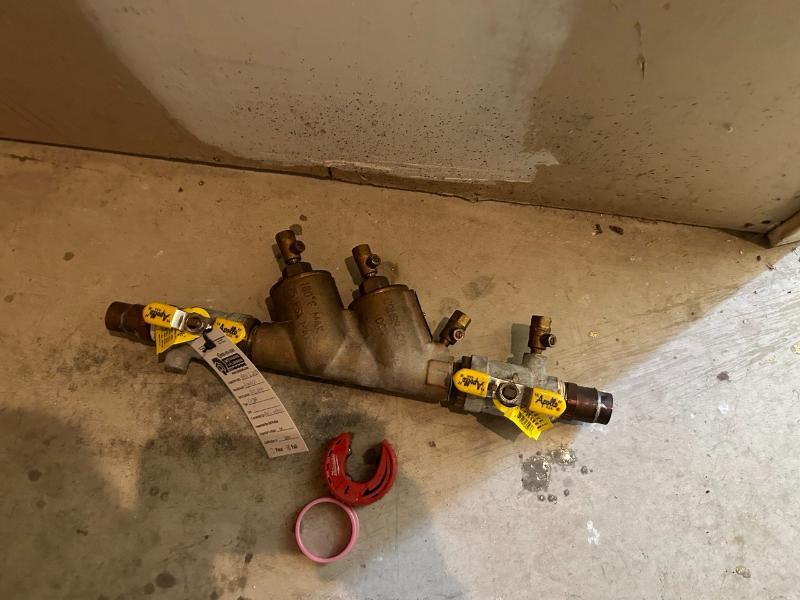
Your device failed its annual test for the second year in a row. The tester says a repair kit will sort it out; your gut says you are paying to patch a valve that was old when you bought the building. Here is how to make that call, and why the clock starts the moment the repair is finished.
Quick answer
- Most first-time failures are worn rubber, tired springs or debris on a check valve seat, and a repair kit fixes them.
- Replace when the device is old and parts are hard to find, it fails repeatedly, the body is corroded, or it is the wrong type for the hazard.
- Repairs and parts are quoted after the test and before any work; you approve a fixed quote first.
- In Toronto, a repaired or replaced device must be retested within 72 hours.
- A replacement is a new installation in Toronto and needs a building permit before the work starts.
Why do backflow preventers fail the annual test?
Most failures come down to a check valve that no longer seals: a worn disc, a weak spring, or a grain of debris sitting on the seat. The gauge shows a reading below the minimum, and the device fails even though water still flows normally.
Other common causes are a relief valve that drips or sticks, seized test cocks, shut-off valves that will not hold, and freeze damage on outdoor assemblies. We cover the symptoms in more detail in common backflow preventer issues.
None of these are visible from the outside. That is why the City requires a calibrated test rather than a visual check.
Which part is failing, and can it be repaired?
Match the symptom on your test report to the table below. Most rows end in a repair; the ones that end in a replacement are about the body of the device, not the parts inside it.
| Symptom on the test | Likely part | Repair or replace |
|---|---|---|
| Check valve reads low or leaks | Check disc, seat or spring; debris | Repair kit |
| RP relief valve drips constantly | First check leaking, or relief valve diaphragm | Repair kit |
| RP relief valve will not open | Relief valve fouled or stuck | Repair; replace if the seat is damaged |
| PVB air inlet will not open | Poppet or spring | Repair kit |
| Test cocks seized or snapped | Test cocks | Replace the test cocks; check the body for corrosion |
| Shut-off valves will not hold | Isolation valves on the assembly | Replace the valves |
| Water weeping from the body, pitting or rust | Corroded body or bolts | Replace the device |
| Cracked body after a freeze | Body | Replace the device |
| Fails again within months of a repair | Several worn parts at once | Replace the device |
When does a repair make sense?
Repair when the body is sound, the device is the right type for the hazard, parts are available, and this is the first failure in years. A repair kit replaces the wearing parts and the device goes back to doing what it was designed for.
- The failure is a single check or relief valve reading, not several at once
- The manufacturer still makes a kit for your model
- No rust, pitting or weeping on the body or bolts
- The device is the type the hazard calls for under CSA B64.10
- It has not been repaired within the past couple of test cycles
When should you stop fixing it and replace?
Replace when any one of five conditions applies: parts are no longer available, the device fails repeatedly, the body is corroded, it was damaged by freezing, or it is the wrong type for the hazard it protects. Repairing in those cases buys a year at best.
- Age and parts. Once a model is discontinued, kits become scarce and expensive. If your tester has to hunt for parts, the next failure will cost more than this one.
- Repeated failures. A device repaired two cycles running is wearing out as a whole. The third repair rarely holds.
- Corrosion. Seals can be replaced; a pitted body cannot. Weeping at the joints means the metal is going.
- Freeze damage. A cracked body is a replacement, full stop.
Wrong device for the hazard: a DCVA on a connection that needs an RP will never be compliant, no matter how many times it passes. If a cross-connection control survey or a change of use has raised the hazard rating, the fix is a new device, not a repair kit.
Device failed? We quote the repair or replacement after the test, never before, and confirm a fixed price before touching a wrench — the $350 annual test covers the diagnosis. Book a test or call (647) 578-9903.
What is the 72-hour retest rule?
In Toronto, any device that is cleaned, repaired, replaced, serviced or overhauled must be retested within 72 hours, and the passing report filed with Toronto Water. The property stays non-compliant until that second report is in.
In practice we test, repair and retest in a single visit wherever parts allow. If a part has to be ordered, the retest is scheduled inside the window before we leave.
A replacement also counts as a new installation under the Water Supply By-law, so a building permit is required and is obtained before the work starts. The new device is then tested at installation and that report is filed too.
What does backflow preventer repair cost?
We do not quote repairs over the phone, because the price depends on which parts failed and whether a kit exists for your model. The $350 annual test covers the calibrated test, tag, report and filing; any repair or replacement is quoted separately once we know what is wrong.
A replacement quote includes the permit, the installation and the test at installation, so you see one number before you decide. Backflow Inspector, a service of MT Drains & Plumbing, handles the test, the repair and the retest as one job, so you are not coordinating two contractors against a 72-hour clock.
Quick answers
Failed test? Get the repair quoted before anyone touches it
The $350 test covers the diagnosis; repair or replacement is quoted separately and confirmed before any work, with the 72-hour retest and filing included.