
One protects your drinking water, the other protects your basement, and they share a name. A side-by-side comparison of where each device sits, who requires it, whether it is tested and who to call.
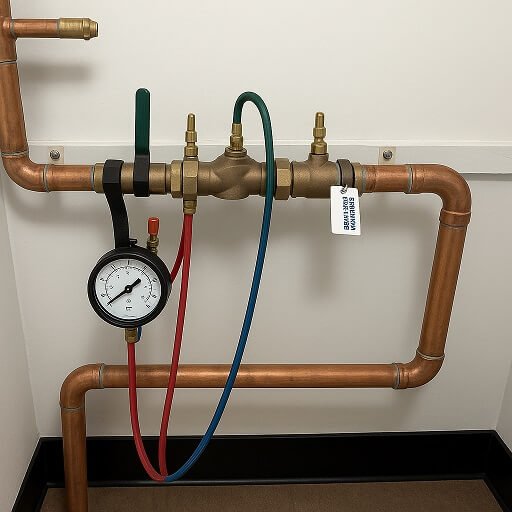
A tenant calls about sewage in the basement, you search for “backflow valve”, and half the results are about drinking water. The two devices share a name, can sit a few metres apart in the same mechanical room, and do completely different jobs. Here is how to tell them apart, and who to call for each.
Quick answer
- A backflow preventer sits on the incoming potable water line and stops contaminated water flowing back into the drinking water supply.
- A backwater valve sits on the sanitary sewer line and stops sewage backing up into the basement during heavy rain.
- Backflow preventers are tested every 12 months and reported to the municipality; backwater valves are not part of any testing program.
- Backflow Inspector tests backflow preventers. MT Drains & Plumbing installs backwater valves.
- Many buildings have both, and need both.
What is the difference between a backflow preventer and a backwater valve?
A backflow preventer protects the drinking water: it sits on the incoming water line and stops water moving backward from your building into the municipal supply. A backwater valve protects the basement: it sits on the sewer line and stops sewage moving backward from the municipal sewer into your building.
Same word, opposite pipes. One is a public health device regulated by the municipality’s water department; the other is a flood protection device that no backflow testing program covers.
| Question | Backflow preventer | Backwater valve |
|---|---|---|
| Where it sits | Incoming potable water line, usually just after the meter | Sanitary sewer line, usually in the basement floor near the floor drain |
| What it protects | The drinking water supply, yours and the City’s | Your basement from sewer backup |
| What it stops | Back pressure and back siphonage of contaminated water | Sewage surging back during heavy rain or a sewer blockage |
| Who requires it | The municipality, under its water by-law (Chapter 851 in Toronto) | No water by-law requirement; installed for flood protection |
| Tested annually? | Yes, by a certified Cross Connection Control Specialist, reported to the City | No annual test program; should be checked and kept clear |
| Who installs it | Licensed plumber, with a building permit | Licensed plumber or drain contractor (MT Drains & Plumbing) |
| Who tests it | Backflow Inspector | Nobody is required to; we do not test them |
How do you tell which one you are looking at?
Follow the pipe. If it comes from the water meter and runs along the wall at waist height, you are looking at a backflow preventer. If it is set into the concrete floor with a round lid near the floor drain, it is a backwater valve.
- Backflow preventer: brass or bronze body, two shut-off valves, four small test cocks, mounted above the floor
- Backflow preventer: a tag hanging from it with a tester’s name and a test result
- RP type: a relief valve underneath with a drain or funnel below it
- Backwater valve: plastic or cast body set into the floor, a removable lid, a hinged flap inside
- Backwater valve: no tag, no gauges, no test cocks
If there is a tag and you cannot read when it was last tested, that is your cue to check whether the device is in test. Our guide to what a backflow preventer is covers the water-side device in more detail.
Does a backwater valve protect you from backflow contamination?
No. A backwater valve has nothing to do with the drinking water. It can be working perfectly while a boiler, irrigation line or fire sprinkler on the water side has no protection at all.
The reverse is also true. A tested, tagged backflow preventer does nothing for the sewer line, and the next heavy rain will find the basement regardless.
If your building has a basement and is a commercial, industrial, institutional or larger multi-unit residential property, you likely need both. Use our 30-second check to see whether the water-side rule applies to you.
Does a backwater valve need an annual test?
Not under any cross-connection control program. No municipality asks for a backwater valve test report, no certification covers it, and Backflow Inspector does not test them.
That does not mean leaving it alone. The flap can jam with debris, so the valve should be opened and cleared from time to time, which is maintenance a plumber or your own staff can handle.
Thinking of installing one? Check the City of Toronto’s basement flooding subsidy program before you book; it can apply to backwater valves on eligible properties. Your installer can tell you whether your building qualifies.
Need the water-side device tested? That is our job: calibrated test, tag, digital report and filing with your municipality for $350 per device, less per device on multi-device sites. Get a fixed quote or call (647) 578-9903.
Who installs and who tests each one?
Two devices, two trades, one phone number. Backwater valves are installed by MT Drains & Plumbing, a Richmond Hill plumbing and drain company. Backflow preventers are installed and tested by Backflow Inspector, a service of MT Drains & Plumbing dedicated to cross-connection control.
The split matters because the water-side device needs a certified Cross Connection Control Specialist, a permit for installation, and a report filed with the City. The sewer-side device needs a drain specialist who can cut into the floor and tie into the sanitary line.
If you call about one and it turns out you need the other, we will say so and route you to the right crew.
Which one does your building actually need?
It depends on what you are protecting against. A history of basement flooding points to a backwater valve; a commercial, industrial or institutional use, a Part 3 residential building, an irrigation system or a pool points to a backflow preventer under the Toronto Water Supply By-law.
Many properties have both, and the mechanical room is where they meet: a brass assembly on the wall, a lid in the floor. Only one of them has a test due every 12 months.
Quick answers
Water side or sewer side? One call sorts both
Backflow Inspector tests and files your backflow preventer for $350 per device; if it turns out you need a backwater valve, MT Drains & Plumbing installs it.